What is Catalyst Cloud?
Catalyst Cloud is a cloud computing platform, based entirely in New Zealand.
Catalyst Cloud was built with the open source project, OpenStack. Using
OpenStack our Cloud allows users like yourself to provision resources.
Provisioning is similar to renting; you can provision things such as storage
space, compute capacity, or Internet access. The building blocks you need to
run a business’s applications.
OpenStack gives you the ability to provision no more or less than what you
need, by allowing you to change how much you are using quickly, easily, and
even automatically, through a variety of tools.
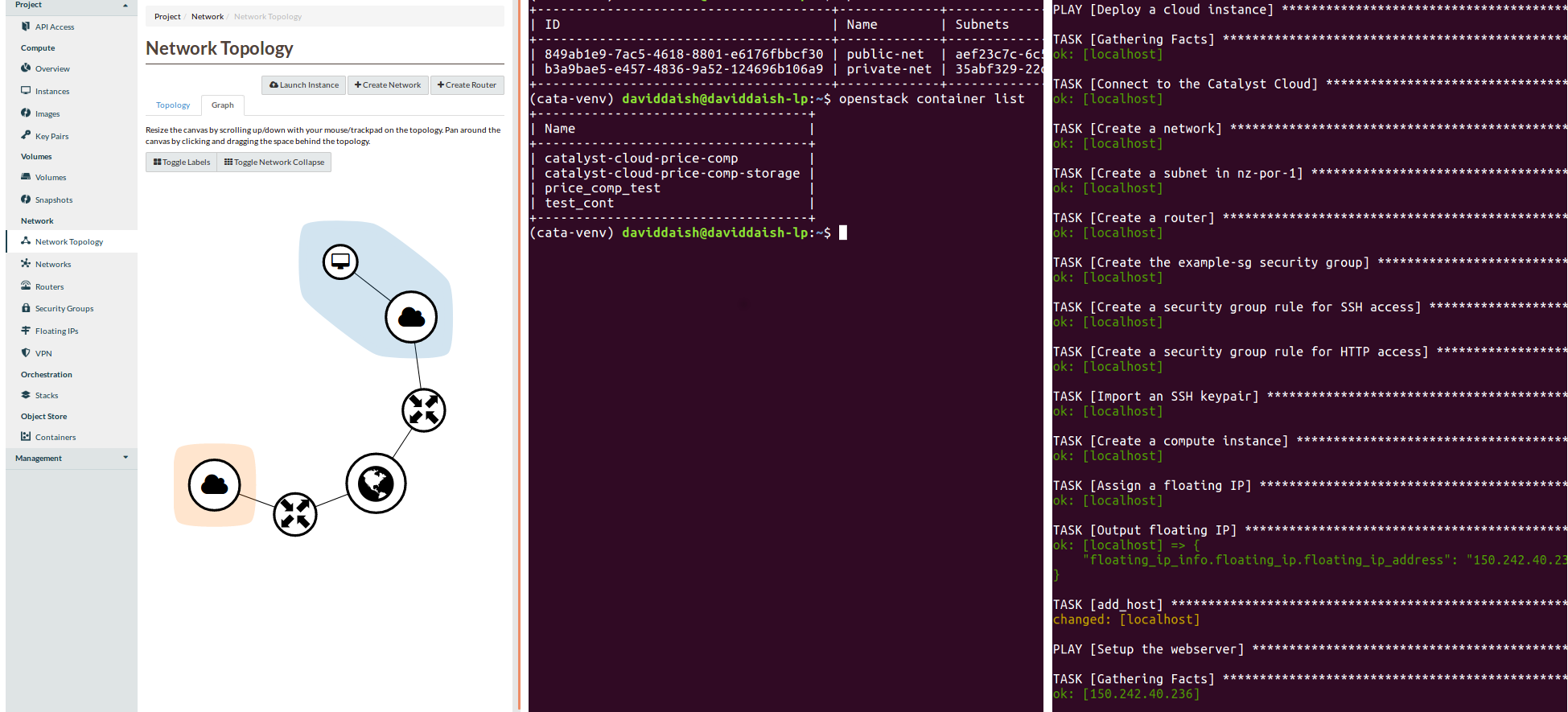
To obtain resources on Catalyst Cloud, you provision services. Catalyst Cloud
services are pieces of hardware and software that we have in one of our data
centres. We make these easy and convenient to use through
a variety of tools including our dashboard web application, the command
line interface or a number of orchestration services
By exposing our hardware and software as services, we remove a lot of
complexity from your day to day work. For example, if you need to give a
server it’s own public IP address you can open a terminal and run:
$ openstack floating ip create public-net

+---------------------+--------------------------------------+
| Field               | Value                                |
+---------------------+--------------------------------------+
| created_at          | None                                 |
| description         | None                                 |
| fixed_ip_address    | None                                 |
| floating_ip_address | 150.242.41.224                       |
| floating_network_id | 849ab1e9-7ac5-4618-8801-xxxxxxxxxxxx |
| id                  | 415fa158-fd7d-4b43-9002-xxxxxxxxxxxx |
| name                | 150.242.41.224                       |
| port_id             | None                                 |
| project_id          | 8ccc3286887e49cbxxxxxx23eba693b4     |
| qos_policy_id       | None                                 |
| revision_number     | None                                 |
| router_id           | None                                 |
| status              | DOWN                                 |
| subnet_id           | None                                 |
| tags                | []                                   |
| updated_at          | None                                 |
+---------------------+--------------------------------------+
Now you have provisioned a public IP address. Now you can run:
$ openstack server add floating ip <my_server_name> 150.242.41.224
Just like that, your server has a public IP address in seconds. Quick, easy
and powerful. Every action on Catalyst Cloud can be performed just as quickly.
Now we understand the basic idea behind Catalyst Cloud, let’s explore what
services Catalyst Cloud provides.
Next page